



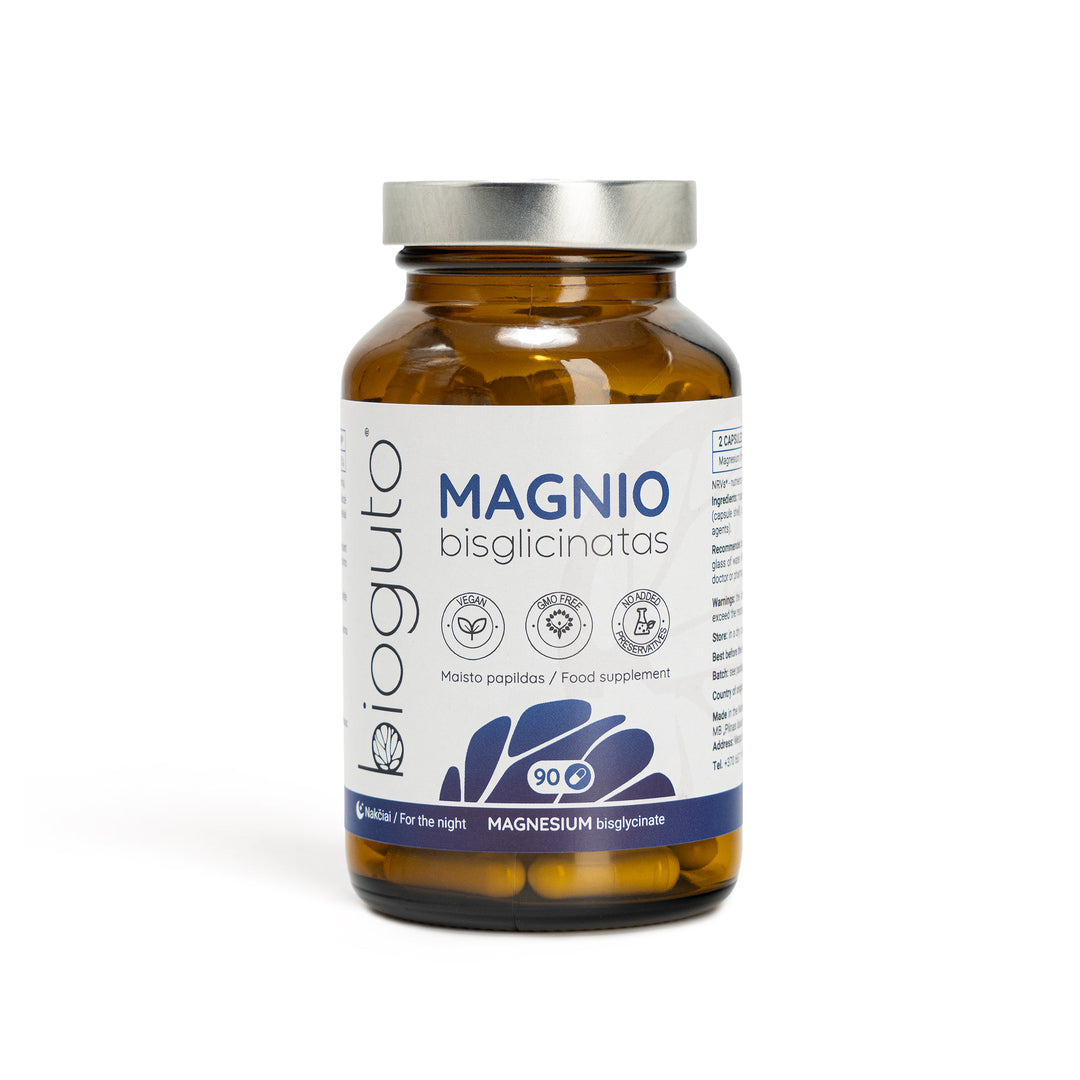



Bioguto Magnesium bisglycinate 60 capsules
BIOGUTO MAGNESIUM BISGLYCINATE – A BIOAVAILABLE AND GENTLE-ON-THE-DIGESTIVE-TRACT FORM OF MAGNESIUM FOR DAILY USE, PARTICULARLY SUITABLE FOR EVENING.
Magnesium helps maintain normal nervous system function, muscle function, energy metabolism, psychological function, and electrolyte balance. Magnesium also helps reduce fatigue and tiredness and supports normal protein synthesis, bone, and tooth health.
1 capsule contains 909 mg of magnesium bisglycinate – equivalent to 100 mg of elemental magnesium.
Suitable for vegans and vegetarians.
Gluten-free, lactose-free, GMO-free, and artificial colorant-free.
Developed in Lithuania.
Food supplement.
Notification number: MP-2012/24
- MAGNESIUM BISGLYCINATE
Magnesium bisglycinate may also be called magnesium glycinate or magnesium glycinate chelate.ChelatesGreek for pincers. Therefore, magnesium bisglycinate consists of magnesium surrounded by two glycine molecules with a kind of pincers. This structure is special and differs from other forms of magnesium in that it does not dissociate into ions in solution.
Why is ionic form important?
First of all, because magnesium in its ionic form is very prone to react with various substances and its absorption can be hindered by other compounds in food, such as phosphates, phytates (in grains, soybeans, leguminous products, etc.), tannins (coffee, cocoa, tea etc.) etc., with which magnesium reacts to form insoluble salts and is removed from the body before it can enter the cells. Magnesium in its ionic form competes with other metal ions for the same transport systems, so high concentrations of other metal ions in the gut (such as calcium) can make it difficult for magnesium to enter cells. The opposite is also possible: if there is a lot of magnesium in the intestines compared to other metal ions, it can interfere with the absorption of other elements.
Which is the better bisglycinate form?
Although magnesium bisglycinate is very soluble in water, it does not dissociate into ions when dissolved and its absorption does not require the mechanisms involved in normal ion absorption. Magnesium bisglycinate enters cells by another route, a kind of VIP, through dipeptide channels. By the way, they are much more abundant in the gut than other common transport systems for metals in their ionic form. For this reason, magnesium bisglycinate is quickly and well absorbed, it does not interfere with the absorption of other metal ions, and its absorption is also not hindered by other metal ions. More importantly, this chelated form of magnesium reduces the toxicity and intestinal irritation of magnesium itself.
Why is glycine important?
Magnesium bisglycinate has two glycine molecules in its structure. Glycine is one of the twenty amino acids most commonly found in proteins. It is the simplest amino acid, necessary for protein synthesis and the body is able to synthesize it on its own. Glycine is also present in our food: meat, fish, dairy products, legumes.
Glycine is important not only as a protein building block. It has many different functions: it increases insulin sensitivity, regulates immunity, functions as a signal transmitter in the brain, improves the functioning of the gastrointestinal tract, reduces oxidative stress, and more. Glycine has been shown to improve sleep quality by helping you fall asleep faster and promoting deeper, more restful sleep.
Highlights of magnesium bisglycinate in brief:
- Very good intestinal absorption.
- Does not react with other substances in food that impair magnesium absorption.
- Inhibition of absorption of other nutritionally important ionic elements is avoided.
- Does not irritate the digestive tract.
- May improve sleep quality thanks to glycine.
- RICE HUSK EXTRACT as tackifiers.
- HYPROMELIOSIS as a capsule shell.
- CONTAINS TRACES OF CITRIC ACID
NUTRIENTS
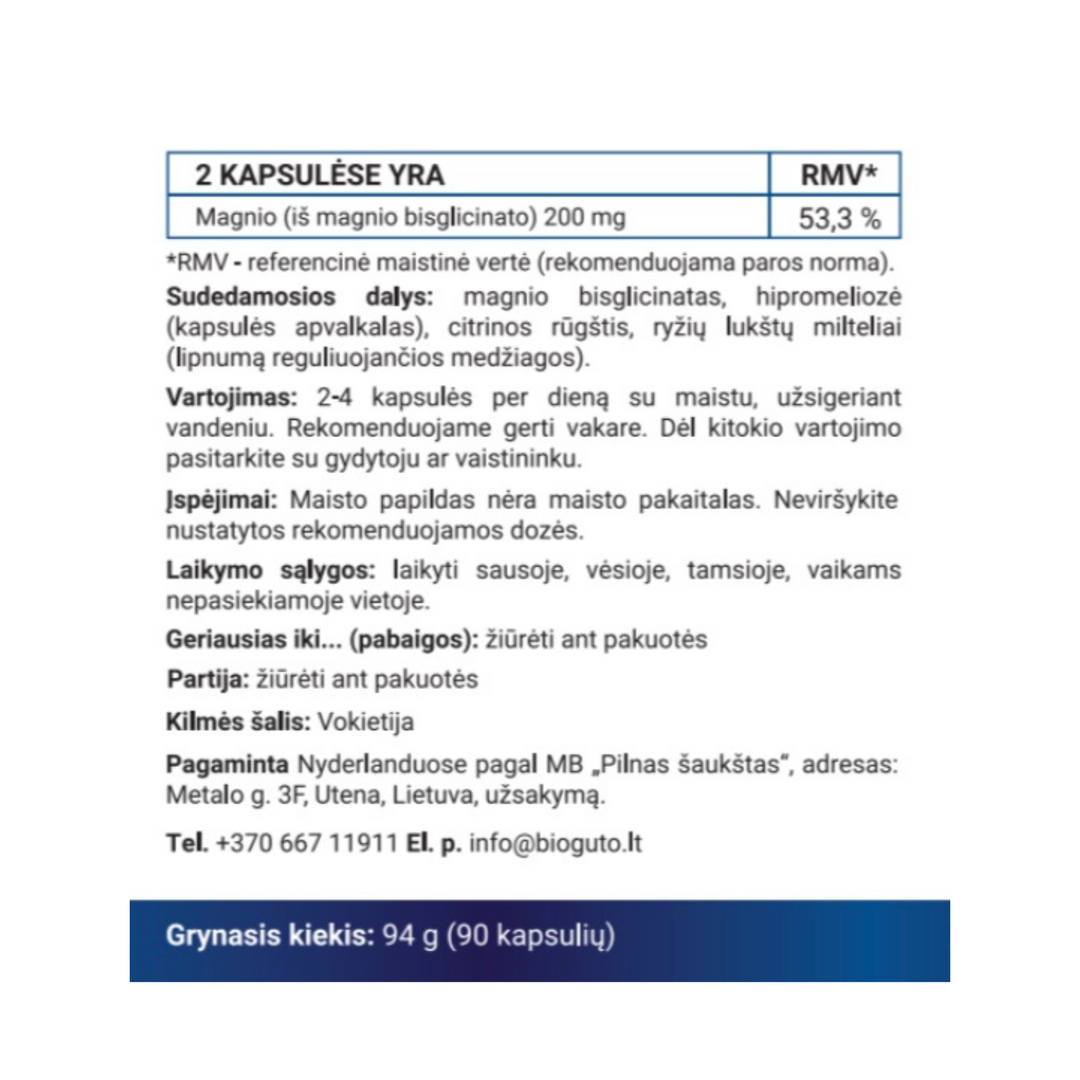
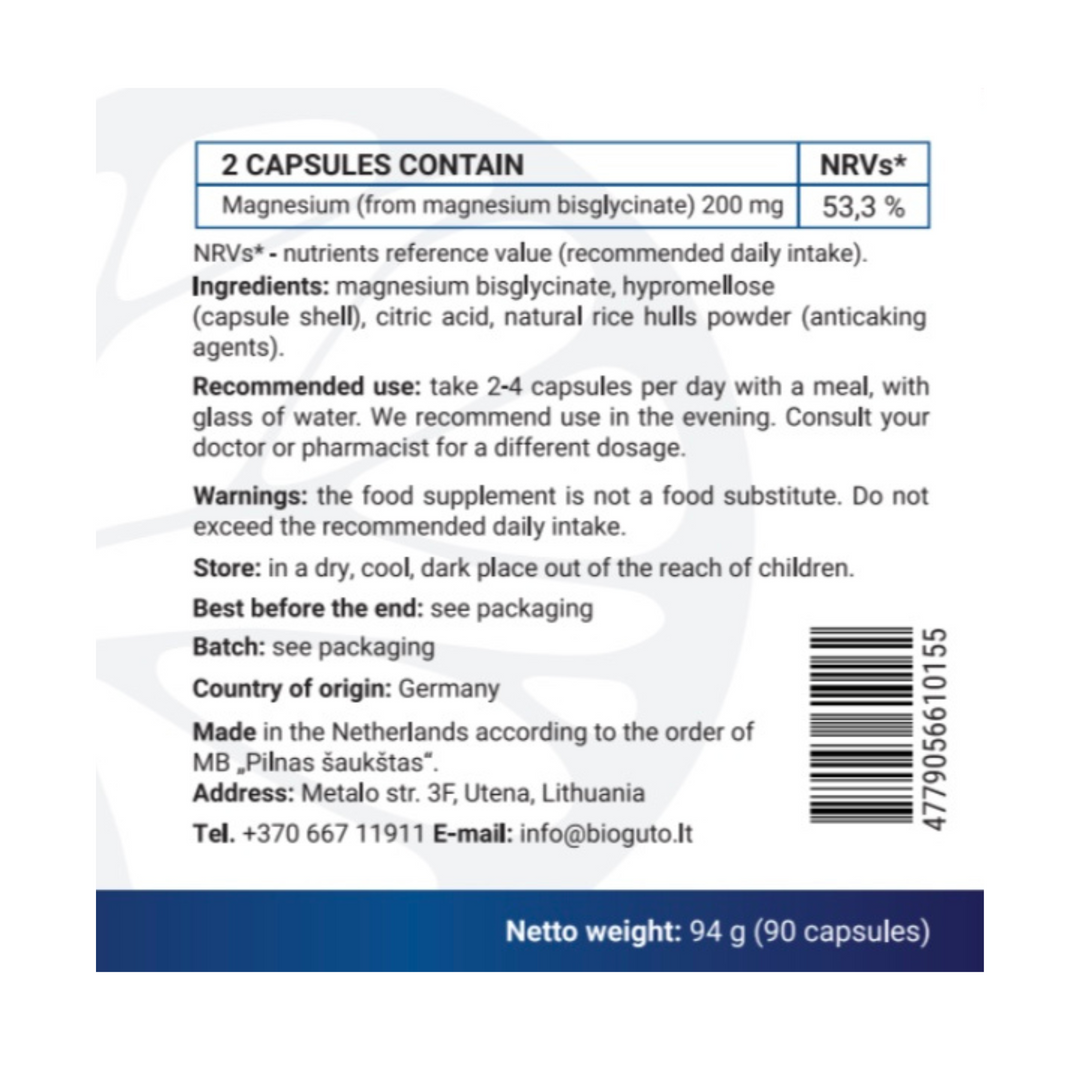
2 CAPSULES CONTAIN
Magnesium (from magnesium bisglycinate)
200 mg
RMV*
54.4%
RMV* - reference nutritional value (recommended daily intake).
- 100 mg magnesium per capsule
- Magnesium bisglycinate form– magnesium bound to two glycine molecules
- Magnesium only– no added B group or other vitamins
- German raw material
- Very gentle on the digestive tract
- Suitable for daily use
- Suitable for evening use
- Suitable for vegans and vegetarians
- Gluten-free
- Lactose-free
- GMO-free
- No artificial colorings
- No artificial flavorings
- Convenient capsule form
- Suitable for children– consult a doctor or pharmacist regarding specific dosage
- Suitable for pregnant and breastfeeding mothers
- If needed, the capsule can be opened and its content mixed with food
- As many as 90 capsules per package
Magnesium helps the body perform many daily functions – from energy metabolism to the normal functioning of the nervous system and muscles.
It is important for maintaining normal nervous system function, muscle function, psychological function, electrolyte balance, and energy metabolism. Magnesium also helps reduce tiredness and fatigue, maintain normal protein synthesis, bone and teeth health, and plays a role in cell division.
In other words, magnesium is a mineral important for every cell in the body and its smooth functioning.
Official EU-authorized health claims for magnesium:
- Magnesium contributes to normal energy-yielding metabolism.
- Magnesium contributes to the reduction of tiredness and fatigue.
- Magnesium contributes to normal muscle function.
- Magnesium contributes to normal functioning of the nervous system.
- Magnesium contributes to normal psychological function.
- Magnesium contributes to the maintenance of normal bones.
- Magnesium contributes to the maintenance of normal teeth.
- Magnesium contributes to normal protein synthesis.
- Magnesium contributes to electrolyte balance.
- Magnesium has a role in the process of cell division.
Claims are presented according toCommission Regulation (EU) No 432/2012establishing a list of permitted health claims made on foods.
Magnesium bisglycinate is a chelated form of magnesium. This means that magnesium is bound to the amino acid glycine. This structure distinguishes this form from conventional magnesium salts.
Chelated magnesium is more stable in the digestive tract and competes less with other minerals for absorption. For this reason, magnesium bisglycinate is often chosen when a highly absorbable form of magnesium is sought.
Another important advantage is that magnesium bisglycinate is typically gentler on the bowels. Some forms of magnesium can cause loose stools or irritate the digestive tract, so bisglycinate is often chosen by people who want to avoid this.
The glycine in magnesium bisglycinate is an amino acid involved in the functioning of the nervous system. Together with magnesium, which helps maintain normal nervous system function and normal psychological function, this form is a good choice for the evening – especially after an active or stressful day.
In short, magnesium bisglycinate is a chelated, well-absorbed, and gut-friendly form of magnesium, suitable for daily use and balanced for evening consumption.
The need for magnesium may be higher with an active lifestyle, more intense physical exertion, profuse sweating, prolonged stress, or an insufficiently varied diet. Magnesium levels in the body can also be affected by certain daily habits, such as higher coffee or alcohol consumption.
Additional attention to magnesium levels may be relevant for those who exercise, experience greater physical or mental strain, often feel stressed, or sweat profusely.
Magnesium requirements can also change during certain health conditions. If you have diabetes, cardiovascular diseases, digestive system or kidney disorders, or if you are taking medications, pregnant or breastfeeding, it is recommended to consult a doctor or pharmacist about magnesium supplementation.
WHEN TO CHOOSE MAGNESIUM BISGLYCINATE AND WHEN MALATE? OR DO YOU NEED BOTH?
Both magnesium bisglycinate and magnesium malate supplement the diet with magnesium. The magnesium in both forms helps maintain normal nervous system function, muscle function, energy metabolism, psychological function, and helps reduce feelings of tiredness and fatigue.
The difference is not in the benefits of magnesium itself, but inthe form of magnesium, its tolerability, and the properties of the molecules combined with magnesium.
Magnesium bisglycinateis more often chosen when a gentle, well-tolerated form of magnesium is sought, especially for evening use. This form of magnesium is often chosen as one of the most versatile options for magnesium supplementation.
Magnesium malateis more often chosen by those who need energy during the day; it is favored by athletes and people who lead an active lifestyle.
Quick selection guide:
- You want to take magnesium in the morning or during the day →Magnesium malate
- You live a more active lifestyle →Magnesium malate
- You exercise or have days with greater physical exertion →Magnesium malate
- You experience greater mental or physical strain →Magnesium malate
- You want to take magnesium in the evening →Magnesium bisglycinate
- You are looking for a gentle, well-tolerated form →Magnesium bisglycinate
- More sensitive digestive tract →Magnesium bisglycinate
- Other forms of magnesium cause laxative effect →Magnesium bisglycinate
- You want a daytime and evening option →Magnesium kit: malate for day + bisglycinate for evening
- You don't know which form to choose →Start with bisglycinate or choose the kit
If you want a simple solution for the whole day, choose the Bioguto magnesium kit: Bioguto Magnesium Malate for the day and Bioguto Magnesium Bisglycinate for the evening.
Adults:take 2 capsules dailywith food and water. If needed, you can take up to 4 capsules daily. Do not exceed the recommended daily dose. We recommend taking it in the evening.
Pregnant and breastfeeding women:suitable for use during pregnancy and breastfeeding, but we recommend consulting your doctor for proper dosing.
Children:suitable for children (if needed, the capsule can be opened and the contents mixed with food), but we recommend consulting a doctor or pharmacist for proper dosing. Children's magnesium needs depend on age, diet, health status, and other supplements being taken.
Approximate Adequate Intake (AI) values for magnesium for children provided by the European Food Safety Authority (EFSA)
Adequate Intake is the approximate amount of magnesium per day from all sources: food, drinks, and supplements, if consumed. This is not a dosing chart for children for this product.
Age Group – Magnesium intake per day
Children 1–<3 years – 170 mg
Children 3–<10 years – 230 mg
Boys 10–<18 years – 300 mg
Girls 10–<18 years – 250 mg
A food supplement is not a substitute for food.
A varied and balanced diet and a healthy lifestyle are important.
Do not exceed the stated recommended daily dose.
Keep out of reach of children.
During pregnancy, breastfeeding, when taking medication, or if you have health problems, it is recommended to consult a doctor or pharmacist about taking food supplements.
Store in a dry, cool, dark place, out of reach of children.
Keep in a tightly closed package
We choose packaging solutions that better protect the product and at the same time allow for more responsible disposal of packaging waste after use.
Bottle
The product is packaged in an amber glass bottle. Darker glass helps protect the product from light exposure, and glass is an infinitely recyclable packaging material.
Cap
An aluminum cap is used. Aluminum can also be recycled, so after use, it is recommended to sort it separately from the glass bottle.
Label
The self-adhesive labels are made using FSC® certified paper. This product's label is made using 99% recycled fiber.
What does FSC® mean?
FSC® is an international responsible forestry certification. It indicates that the raw material used for paper production comes from responsibly managed forests, controlled sources, and/or recycled materials.
HOW TO SORT THE PACKAGING?
Before sorting, we recommend completely emptying the bottle.
How to sort the packaging?
- Amber glass bottle – into the glass container.
- Aluminum cap – into the metal and plastic container.
- Label – can be left on the bottle or put with paper waste.
Manufactured in the Netherlands for MB "Pilnas šaukštas"
Address: Metalo g. 3F, Utena, Lithuania,
Tel. +370 667 11911
Email: info@bioguto.lt
Within 2–4business days.
Is this magnesium suitable for vegans?
Yes, the product is suitable for vegans and vegetarians.
Does it contain gluten?
No, the product is gluten-free.
Does it contain lactose?
No, the product is lactose-free.
When is the best time to take magnesium bisglycinate?
It is recommended to take it with food and water. It is convenient to take in the evening or as needed.
How much magnesium is in one serving?
2 capsules contain 200 mg of magnesium.
Can it be taken daily?
Yes, the product is intended for daily use, adhering to the recommended daily dose.
Can children take it?
Yes, but for specific dosage for a child, we recommend consulting a doctor or pharmacist.
Can pregnant and breastfeeding women take it?
Yes, but for specific dosage, we recommend consulting your supervising physician.
Which country is this supplement from?
Bioguto is a Lithuanian brand, so all Bioguto products are born in Lithuania. Bioguto Magnesium Bisglycinate is manufactured in the Netherlands, using German raw materials.